Kathmandu. The New York Times reports (12 October) that China has begun fencing its border with Nepal and in some parts encroaching on Nepalese territory. China’s ‘New Great Wall’ is not just creeping territorial aggression but is also an exercise in coercive diplomacy along the border. Of far greater import is the fact that China is attempting to impose its anti-Dalai Lama policy on the Tibetans settled in Nepal.
Territorial aggression is not new to China and apart from Nepal, Bhutan has continued to feel the pressure. For China, the key is to ensure that the Dalai Lama is not worshipped by Tibetans either in Tibet or Nepal. That is why its agencies are engaged in a negative campaign to vilify the Dalai Lama in Nepal.
The fence constructed on the border with Nepal reveals a Chinese mindset that cannot tolerate others, especially those who espouse the cause of Tibet. China views the cultural and religious links between Tibet and Nepal, more importantly, the influence of the Dalai Lama, as a threat to stability in the region.
That is why it has been trying to weaken the Dalai Lama’s significant influence in Nepal and sway over local communities by promoting Chinese Buddhism. Therefore, in addition to making territorial claims, China’s security forces are pressuring ethnic Tibetan Nepalis in the Humla district “not to display images of the Dalai Lama.” High on the Tibetan Plateau, the China has carved a 600-feet-long message on a hillside:
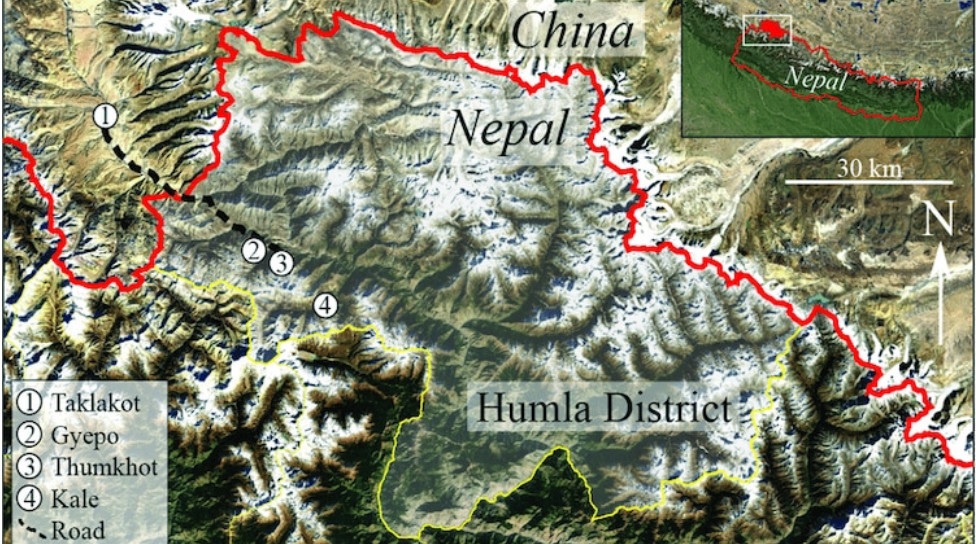
“Long live the Chinese Communist Party,” inscribed in characters that can be read from orbit. Nepal may be shy to admit it, but facts on the ground show that China has been pushing its border in occupied-Tibet into Nepal, by laying fences. The NYT report highlights the case of Humla, a frontier village in Nepal’s Karnali province, now confronted with Chinese barbed wire fences and ongoing encroachment.
In 2021, Nepalese lawmaker Jeevan Bahadur Shahi had published a report which exposed Chinese military encroachments in the Humla district. On the border, there is a huge Chinese customs office, immigration offices and other infrastructures of China on the right of the bank of the Karnali River in western Nepal’s Hilsa village, on the border of Tibet.
There is also a fence is built by Chinese to prevent Tibetans from entering Nepal. CCTV cameras have been installed on the Chinese side to monitor cross-border activities. With the recent proliferation of the Chinese fence, the trans-Tibetan people have been divided. In the last decade, the stream of thousands of Tibetans who once escaped repression by the Chinese state by fleeing to Nepal is today down to a trickle.
The higher and northern parts of Humla are mostly inhabited by Tibetan communities. The border fencing has been combined with the construction border villages overnight, reflecting the strategy adopted by President Xi Jinping in China’s relations with countries on its periphery. China has intensified efforts to “assert its territorial claims in disputed areas along its periphery,” the NYT report states.
Since October 2019, China has been pushing Nepal to sign an “extradition treaty”. Then President Xi Jinping had visited Nepal and Beijing wanted this treaty as one of the deliverables. The Communist-led government under Prime Minister K.P. Oli introduced the treaty for consideration of the Nepalese Parliament but later withdrew it following objections from civil society and international human rights organisations.
It was rightly argued that the treaty could jeopardise the future of thousands of Tibetan refugees who arrived in Nepal after 1990 and had not been issued refugee cards. However, in the joint statement, China “expressed hope for an early conclusion of the Treaty on Extradition.” As the NYT report aptly notes, a treaty of this kind if signed, would assist China to legally pressurize Nepal to curtail the activities of Tibetan refugees, who have often been active in advocating for a “free Tibet”.
That China begets others territory is a well-known fact in South Asia. China’s claims on Nepal’s territory, therefore, should not be seen as a standalone event. Notably, in the last five years alone, China has aggressively and systematically laid claim to Ladakh, Nepal, Sikkim, Bhutan, and Arunachal Pradesh. In Bhutan, the only country in South Asia bordering China that does not have any diplomatic ties with Beijing, China has laid claim to the Buddhist cultural area of Beyul Khenpajong in the north.
The two sides have been negotiating a border resolution since 1984, and the last, or 25th round, of the boundary talks took place in October 2023. Bhutan’s then-Foreign Minister, Tandi Dorji, travelled with a delegation to Beijing and both sides agreed to a “Three-Step Roadmap”. There has been no progress since then, only that the 14th Expert Group Meeting was held between both sides in August 2024. Even as the talks are ongoing, China has chosen to consciously alter the status quo and built 22 villages and settlements (Xiaokong) within Bhutan’s traditional borders.
Nineteen villages and three small settlements are within Bhutan! A recent research study by Turquoise Roof, shows that three of the villages are set to be upgraded to towns. Pertinently, seven of these cross-border constructions have been noticed and imaged since early 2023, indicating significant acceleration in the development of annexed areas. It is estimated that approximately 7,000 people, along with an unknown number of officials, construction workers, border police, and military, are being relocated to these previously unpopulated areas.
A significant aspect of these constructions is stated to be their connectivity; that all are linked by roads to Chinese towns. China’s land grab in Nepal is another sign that it will go to any length to ensure that its security, even at the cost of other nations, is upheld. Illegal encroachment has now become the Chinese norm. So has Chinese strategy to dissuade Tibetans in the region from giving their respects or praying to the Dalai Lama. This reality must sink in.
The construction of Xiaokong villages all along the border with India, Nepal and Bhutan is part of the long-term settlement strategy that has the objective of being able to claim more and more territory as Chinese. The salami-slicing Chinese strategy needs to be addressed by the international community or else when China invades Taiwan, the world will remain a mute spectator.