On the surface, the July Declaration launched in Dhaka reads like a triumphant statement. It celebrates the fall of Sheikh Hasina’s government and the symbolic end of a long cycle of repression and democratic backsliding. Yet beneath the rhetoric of liberation, the document offers little in the way of stability, unity, or justice. It is not a blueprint for reconciliation. It is a manifesto for revenge.
The Declaration is not content to condemn Hasina’s authoritarian drift. It attempts to rewrite Bangladesh’s entire post-independence history through a narrow ideological lens. The Awami League is branded as a fascist party, its sixteen years in office described as nothing but “abduction and murder, unlawful killings, suppression of freedom of speech and constitutional changes in the interest of the ruling party.” Elections are dismissed as “farcical.” The implication is clear: everything from 2008 to 2024 was illegitimate. Laws, parliaments, ministries—all stripped of democratic agency.
This is not accountability. It is historical erasure. And it sits comfortably alongside the broader campaign of revisionism already underway under the Yunus government.
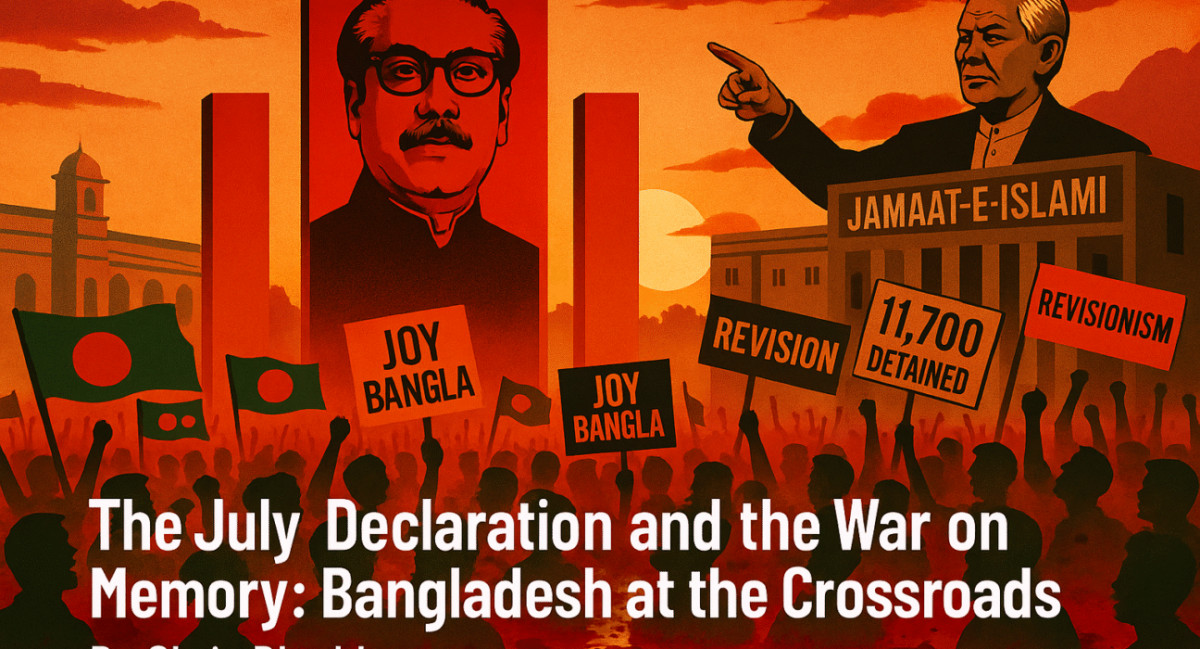
In October 2024, eight national days linked to Sheikh Mujibur Rahman, including the UNESCO-recognised 7 March speech, were wiped from the calendar. Mujib’s face has been erased from currency. “Joy Bangla” has been downgraded from the national slogan to a criminal offence—students have been arrested for chanting it. School textbooks now present Ziaur Rahman as the true declarant of independence, while Mujib’s centrality is quietly excised. Jamaat-e-Islami, once banned for collaborating with Pakistan in 1971, is back in the political fold.
This is not neutral reform. It is the systematic dismantling of a nation’s founding grammar.
The Declaration reflects the same spirit. It demands the trial of anyone associated with the Awami League, accusing them en masse of “crimes against humanity.” No legal standards are offered. No distinction is drawn between perpetrators of violence and millions of ordinary civil servants, teachers, or citizens who supported the AL out of conviction, not fear. There is no language of reconciliation, only purges.
The irony is hard to miss. For decades, critics accused Sheikh Hasina of inflating Mujib’s legacy to the level of cult. Now, Yunus and his allies are responding not by correcting the record, but by detonating it. One orthodoxy is being replaced with another. History is not being opened up. It is being weaponised.
The danger is not just symbolic. Once a state claims that the past is illegitimate, it licenses exclusion in the present. Since Sheikh Hasina’s fall, the scale of political retribution has been staggering. Between August and late September 2024, police filed cases against more than 92,000 people, including hundreds of former ministers, MPs and Awami League officials. That was only the beginning.
In February 2025, the interim government launched “Operation Devil Hunt,” a sweeping campaign it claimed was aimed at organised criminality tied to the former regime. Within weeks, over 12,000 people had been arrested nationwide. The United Nations, meanwhile, estimates that at least 11,700 people were detained in connection with the student-led protests that helped bring down the old order.
Taken together, these figures suggest that well over 115,000 individuals have been caught in the dragnet of the new regime. Some were violent actors. Many were not. When arrests are carried out at such scale and speed, the distinction between justice and vendetta collapses. At least ten detainees have died in custody, officially recorded as “heart attacks.” The truth, like the justice system itself, remains murky.
Minorities have felt the sharpest edge of this climate. More than 2,000 attacks on Hindus have been recorded since the uprising. Christian homes have been torched in Bandarban. Hindu teachers have been forced from their posts. Extremists thrive in this atmosphere. When governments wage war on memory, zealots wage war on people.
The July Declaration even goes so far as to demand constitutional recognition for the 2024 student uprising—an effort to elevate a single political movement to sacred text. States that turn moments of upheaval into permanent scripture rarely evolve into pluralist democracies. They curdle into exclusionary regimes.
The international community should read the July Declaration for what it is: a warning. Bangladesh is not being rebuilt. It is being hollowed out by historical revisionism, fear politics, and vendetta. Investors, allies, and development partners will hesitate to commit to a state that cannot provide narrative stability, let alone rule of law.
Bangladesh has always struggled with contested memory. Mujib’s legacy was elevated to dominance under Hasina, often at the expense of others. But Yunus’s project goes further—it seeks to flatten history itself. A nation cannot thrive by annihilating its past.
Accountability for repression must come. Justice for disappearances, killings, and corruption is essential. But that justice must be institutional, not revolutionary. It must be guided by law, not mob anger. Most importantly, it must make room for every citizen—including those who served, voted for, or remained silent under the Awami League. They are not enemies of the state. They are part of its fabric. Bangladesh needs peace and reconciliation. It’s as clear as day. Yunus is failing. He’s riding on waves of extremism.
The July Declaration claims to embody “the aspirations of the people.” In reality, it reflects the rage of one camp. Popularity in the streets is not the same as legitimacy. By criminalising Mujib, silencing “Joy Bangla,” rehabilitating Jamaat, and declaring the Awami League outside the national story, Yunus has chosen revenge over reconciliation. That is not statesmanship. It is vandalism of memory.
History does not belong to victors. It belongs to the people. Bangladesh must reclaim it before it is lost to revisionists, zealots, and opportunists who would rather erase the republic than truly reform it.