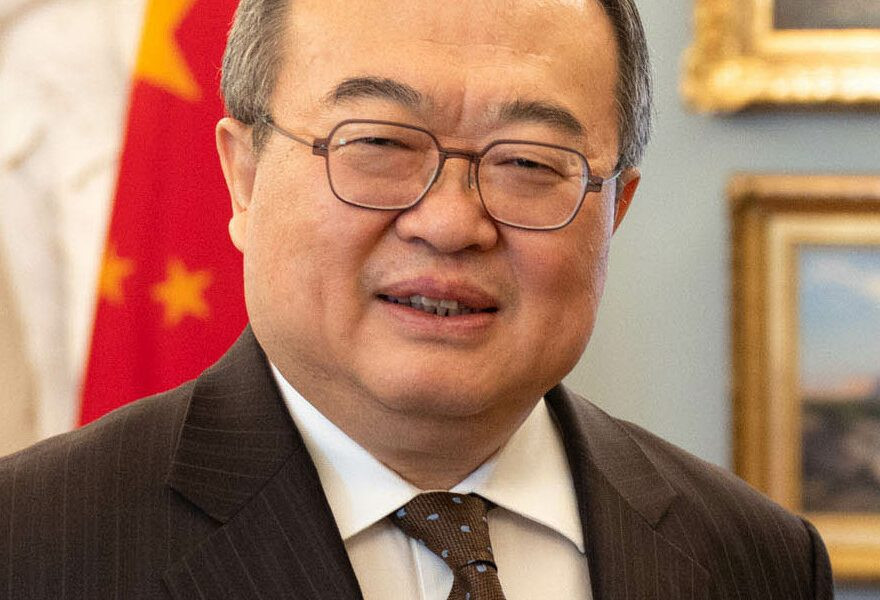
BEIJING: In late July 2025, Senior Chinese diplomat Liu Jianchao, widely regarded as a frontrunner to become China’s next foreign minister, was detained for questioning upon his return to Beijing. His arrest has sent shockwaves through China’s political and diplomatic circles, coming at a time when the Communist Party of China (CPC) is grappling with visible internal fractures.
Liu, known for his sharp wit and polished delivery, had served since 2022 as head of the CPC’s International Department, which manages relations with foreign political parties and socialist states. In that role, he travelled to 20 nations and held over 160 meetings, often engaging counterparts from Western democracies in ways unusual for his predecessors. His career path underscored both his skill as a diplomat and his deep integration into President Xi Jinping’s political network.
A Career Built on Xi’s Trust
Liu’s closeness to Xi was cemented through a career that combined foreign service and anti-corruption enforcement, the latter a portfolio reserved for the most trusted inner circle. After serving as Ambassador to the Philippines and Indonesia, he was promoted to Assistant Foreign Minister in 2013. In 2015, he was handpicked to lead the International Cooperation Office of the Central Commission for Discipline Inspection (CCDI), becoming a key figure in ‘Operation Fox Hunt’, Xi’s global drive to repatriate fugitive officials accused of graft.
In 2017, Liu spearheaded the launch of a provincial-level “supervisory commission” in Zhejiang, a new graft-fighting body that was expanded nationwide in 2018 to police all public-sector employees. This unusual switch from diplomacy to high-level discipline enforcement marked him as a dual-track operator trusted to execute politically sensitive missions. Liu returned to the Foreign Service in 2018 as a senior official in the Xi-led Central Foreign Affairs Commission, before taking over the International Department in 2022 and joining the elite Central Committee.
From Loyal Enforcer to Purged Official
Liu’s detention marks the second high-profile disappearance of a top diplomat in recent years, following the abrupt removal of Foreign Minister Qin Gang in July 2023 amid rumours of misconduct and national security breaches. Both Qin and Liu were Xi loyalists, personally elevated to their posts, which raises questions about why the president is now purging his own trusted appointees, or is it someone else making the decisions to weaken Xi’s hold on power?
Certain parallels can be seen with recent military purges, where entire units of top brass were removed despite being considered politically reliable. The CPC’s top appointments have long been based on loyalty over competence, but the removal of loyalists suggests deeper factional realignment. It points to an erosion of Xi’s absolute control and the reassertion of collective leadership norms among party elites.
Structural Changes Signal Shifting Power
The backdrop to Liu’s detention is a quiet but significant rollback of Xi-era institutional innovations. Recent reforms have reduced the authority of “central commissions” and “leading small groups”, policy coordination bodies Xi created to bypass ministries and consolidate decision-making in his hands. Weakening these structures is widely seen as an attempt by other senior leaders to dilute Xi’s control.
Currently, the CPC’s senior leadership have convened in Beidaihe for the annual summer retreat, a behind-closed-doors gathering where top figures decide personnel changes and strategic direction. The combination of an elite diplomatic arrest, institutional downgrades, and a high-level conclave has fuelled speculation that the Beidaihe meetings could reshape not just the policy direction but the balance of power within the party itself.
The CPC and Liu’s department have made no public comment on his detention. But the message inside the party is clear: in today’s China, no one, not even Xi’s most trusted operatives, is beyond reach.