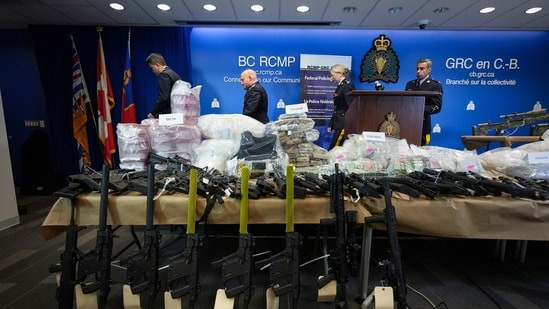
The Royal Canadian Mounted Police (RCMP) recently dismantled what they described as the largest and most sophisticated drug superlab in Canada. This operation, located in Falkland, British Columbia, was linked to a transnational organised crime group involved in the mass production and distribution of fentanyl and methamphetamine. The RCMP seized a staggering amount of drugs, including 54 kilograms of fentanyl and 390 kilograms of methamphetamine, along with precursor chemicals, firearms, and other illegal items. The searches also yielded small explosive devices, large amounts of ammunition, firearm silencers, high-capacity magazines, body armour, and US$ 500,000 in cash.
The 95 million potentially lethal doses of Fentanyl that have been seized, could have taken the lives of every Canadian, at least twice over! Gaganpreet Randhawa was identified as the main suspect, and arrested by Federal Policing Group-6 investigators. Randhawa is currently in custody, and has been charged with numerous drug, and firearms-related offences.
Previously, on October 17, the RCMP had announced the busting of a Mexican Cartel-linked criminal network that has been moving large amounts of methamphetamine and cocaine from Central and South America via the United States to Canada and overseas.
According to the US FBI, 43-year-old Canadian Ryan James Wedding, a former Olympianompeted for Canada in the 2002 Winter Olympics in Salt Lake City, became the “Boss” of a multinational drug-trafficking ring that allegedly moved tens of millions of dollars worth of cocaine across four countries and ordered four murders in Canada. FBI Operation Giant Slalom, Ryan James Wedding ran a criminal network that has also been commissioning murders across North America, and laundering significant proceeds of crime. Wedding, remains at large. He is wanted by the United States and Canada on separate charges. “As alleged in the indictment, an Olympic athlete-turned-drug lord [Wedding] is now charged with leading a transnational organised crime group that engaged in cocaine trafficking and murder, including of innocent civilians,” said United States Attorney Martin Estrada in Los Angeles.
As part of FBI Operation Giant Slalom, US authorities have indicted 16 people, including 10 Canadians, for a range of serious charges including drug trafficking, murder, conspiracy to murder and continuing a criminal enterprise. Four Canadians including Hardeep Ratte, Gurpreet Singh have been arrested in Ontario by local Canadian law enforcement at the request of United States authorities, pending extradition. Three Canadian individuals Nahim Jorge Bonilla, Ranjit Singh Rowal, and Iqbal Singh Virk, were also arrested in the US.
Canadian criminal gangs have been deeply involved in narco trafficking, with several notable groups making headlines. Diverse and tech-savvy gangs are known for trafficking cocaine from Mexico into Canada. These gangs have been described as a new breed of organised criminals, leveraging their intelligence and technological skills to operate efficiently.
Another significant operation was recently dismantled by the RCMP and FBI, known as Operation Dead Hand. This cross-border operation involved large quantities of narcotics being smuggled from Mexico into the U.S. and Canada by long-haul truckers.
The Criminal Intelligence Service Canada has identified British Columbia (B.C.) as having a large number of high-level organised crime groups, many of which have interprovincial and international connections. Organised crime in B.C. is a significant issue, with various high-threat criminal groups operating in the region. The province’s port access and proximity to Mexico make it a natural gateway for illicit drugs into other parts of Western Canada. These groups are involved in a range of criminal activities, such as drug trafficking, money laundering, and illegal gambling. Indo-Canadian organised crime is made up predominantly of young adults and teenagers of Indian ethnic, cultural and linguistic background. The 2004 RCMP British Columbia Annual Police Report ranked them third in terms of organisation and sophistication in British Columbia.
While a lot of the young men involved today in organised crime in Canada come from first-generation backgrounds, the majority are second and third-generation Punjabi-Canadians. The vast majority of gang-affiliated Indo-Canadians in Canada have Sikh ancestry and names.
Indo Canadian gang violence dates back to the early 1990s but garnered substantial media attention with the 1998 death of Bindy Johal. He was the “penultimate hero in Punjabi-Canadian gang lore”. He and rival Ron Dosanjh held a very public television dispute in which Dosanjh threatened to ‘put a bullet’ between Johal’s eyes. However, he never got the chance as he was shot and killed while driving down Kingsway Avenue in Burnaby, BC. In 2012 well-known Vancouver gangster Ranjit Singh Cheema, who ran a major drug-smuggling operation was gunned down in a drive-by shootout, at his parents’ home in East Vancouver. Cheema fought extradition to the U.S. for nearly 10 years after he was charged in 1998 with planning to bring 200 kilograms of heroin from Pakistan in a trade for 800 kg of cocaine with California-based Colombian drug traffickers — a deal that would have earned him between $12 and $14 million. Other known gangs are the Brothers Keepers founded by Gavinder Singh Grewal and Barinder “Shrek” Dhaliwal, the Dhaliwal Crime Family, Dhak-Duhre group, the Sanghera Crime Family, the Malli-Buttar group, Kang Crime Family founded by brothers Sameet Singh “Sam” Kang and Gary Singh Kang, the Manj Crime Group and several others
The Indo-Canadian or Punjabi Mafia is affiliated and consists of several groups which sometimes work together. These groups are still active and notorious in Vancouver. They have been linked to the Independent Soldiers (IS), Red Scorpions, Lotus Triads, Hells Angels, and the United Nations (UN) gang in Canada although several members of the Independent Soldiers can also be grouped as part of the mafia as well. According to Johal’s former lieutenant Bal Buttar, Punjabi Mafia hitmen claimed contracts in B.C. They are responsible for dozens of murders in Canada in the 90s alone and the majority of those murders still remain unsolved.
So since the early 1990s, Indo-Canadian gang involvement has been a hot-button issue in Metro Vancouver. Some of the high-profile cases, such as the Dosanjh Brothers and Bindy Johal even inspired the Canadian film Beeba Boys (2015).
Recently, there have been several high-profile incidents involving Punjabi gangsters in Canada. For example, Abhijeet Kingra, a suspected member of the Lawrence Bishnoi gang, was arrested for his involvement in a shooting incident at Punjabi singer AP Dhillon’s home. Another notable figure is Goldy Brar, who was linked to the murder of Punjabi singer Sidhu Moosewala and has been involved in various criminal activities. These cases highlight the ongoing presence and influence of Punjabi gangsters in Canada’s organised crime scene.
In their work on Indo-Canadian gangs in Drugs, and Violent Crime among Canadian Youth: Facts, Trends, Issues, and Implications for Teachers, Schools, and Policymakers (2006), Louis A. Pagliaro and Ann Marie Pagliaro of the University of Alberta’s Substance Abusology and Clinical Pharmacology Research Group, say that about 40 Indo-Canadian gangs were active in British Columbia at the time of the publication of their paper. The amount of guns that Indo-Canadian gangsters had was “astounding”. The root of the problem lay in the easy availability of drugs, British Columbia’s lax drug laws and a climate of permissiveness in the immigrant Sikhs’ social system.
For instance, Red Scorpions have been running “dial-a-dope lines” – (drug trafficking operations) in the suburbs of Vancouver since 2005 . Gang members can be identified by “RS” tattoos on their arms and necks; any form of skull tattoos usually indicates a member who has carried out a murder for the gang.
A major drug bust conducted in April 2021 broke up an Indo-Canadian trafficking network primarily based in Brampton, Ontario. Of the 28 arrested, the majority were India-born Punjabi men. Police seized $2.3 million worth of drugs including 10 kilograms of cocaine, eight kilograms of ketamine, three kilograms of heroin and 2.5 kilograms of opium. Additionally, 48 firearms and $730,000 in Canadian currency were seized as part of the bust.
Outlaw motorcycle gangs in Canada, such as the Hells Angels and the Red Devils, have been heavily involved in drug trafficking. These gangs have been known to participate in the distribution of drugs like cocaine, methamphetamine, and fentanyl. Recent investigations, such as Project Skylark, have led to the arrest of several members and associates of these gangs, disrupting their drug trafficking networks. These operations have highlighted the gangs’ willingness to use violence and intimidation to maintain control over their territories. The impact of these activities on communities is significant, contributing to increased drug abuse, violence, and social instability.
According to the “2021 Report: Organized Crime in Canada” published by Criminal Intelligence Service Canada, over 2,600 Organized Crime Groups (OCGs) continue to contribute to the increasing number of fentanyl-related deaths, methamphetamine addiction, and firearms related violence.There are common patterns among high-threat OCGs networks, such as outlaw motorcycle gangs and mafia-related ones which include using violence as an integral part of their strategy, infiltrating law enforcement, security, government agencies and the private sector, extensive criminal associations to other OCGs, and having an interprovincial and international scope. The report states that street gangs use social media to encourage violence. They are also involved in most OCG-related public shootings and open acts of violence; putting innocent bystanders at risk.
Canada has indeed become a significant hub for drug trafficking, largely due to its strategic location and extensive transportation networks. The country serves as a transit point for drugs like fentanyl, heroin, and cocaine, which are often smuggled in from countries such as China, Mexico, and Colombia. The recent bust of the largest and most sophisticated drug superlab in British Columbia underscores the scale of the issue.