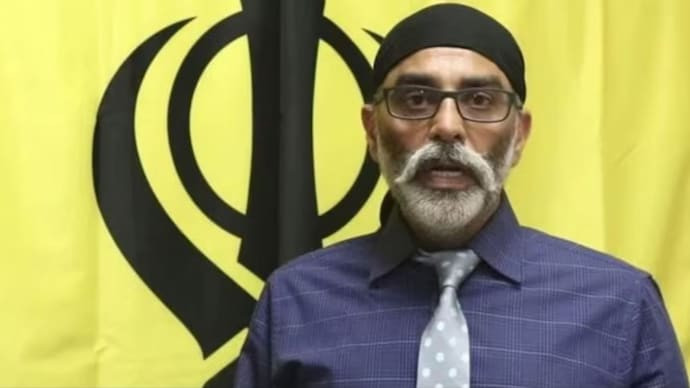
The situation involving Gurpatwant Singh Pannu, a leader of the Khalistani extremist group Sikhs for Justice (SFJ), has raised questions and concerns. Pannu, an American and Canadian citizen, has been involved in activities that India considers to be terrorist actions.
Gurpatwant Singh Pannu moved to the United States in 1992. He has been residing there since then and has established himself as a lawyer and a prominent leader of the Khalistan movement for a separate Sikh state. Pannu is a dual citizen of the United States and Canada. Pannu’s separatist group Sikhs for Justice (SFJ) has been involved in various activities aimed at promoting the creation of Khalistan. Pannu, who resides in the United States, has been designated as a terrorist by the Indian government and has faced multiple legal actions and bans.
SFJ has been accused of inciting violence, making threats against Indian officials, and attempting to destabilize the region through various means, including social media campaigns and public threats. The group has also been involved in organizing events and rallies around the world to garner support for their cause.
He and his organisation have made multiple threats against India and its government over the years, earning him the tag of terrorist and banning his group from operating in the country. In January this year, an Unlawful Activities (Prevention) Act (UAPA) tribunal in Delhi upheld the Indian government’s decision of banning the SFJ for five years.
The Khalistan movement remains a significant security concern for India. The movement, which seeks to establish a separate Sikh state called Khalistan in the Punjab region, has a history of violence and unrest. Although the intensity of the insurgency has decreased, the movement continues to evoke sympathy and support among sections of the Sikh diaspora, and India remains vigilant about potential threats and continues to address the issue through diplomatic channels and security measures
Despite this background, there have been instances where the US has been perceived as providing a platform for Khalistan activists to voice their opinions. This has led to tensions with India, which views the Khalistan movement as a separatist and terrorist organization. For example, Pannu has been able to operate from the US. The US has also thwarted plots against Pannu, indicating that while the US does not support the movement, it does take action against threats to individuals associated with it.
In late November 2023, the United States claimed to have thwarted a plot to assassinate Gurpatwant Singh Pannu, a Sikh separatist leader, on American soil. US authorities proclaimed to have uncovered The plot and later who identified and arrested an Indian national, Nikhil Gupta, who was allegedly working with an Indian government official to carry out the assassination. Gupta was detained in Prague and later extradited to the US to face charges.
The US Attorney’s Office for the Southern District of New York announced charges of “murder-for-hire and money laundering” against Gupta. India’s Ministry of External Affairs responded by stating that Gupta was no longer employed by the government and rejected accusations of official involvement in the plot as “unwarranted” and “unsubstantiated”.
The incident has led to diplomatic tensions between the US and India, with Washington raising the issue with New Delhi at the highest levels This incident has led to allegations that US intelligence agencies might be protecting anti-India assets.The US authorities’ intervention and the subsequent diplomatic exchanges have fueled these allegations.
SFJ launched the Referendum 2020 campaign, calling for a vote on whether Punjab should secede from India. They held an unsanctioned referendum in London in October 2021. SFJ has been accused of inciting Sikh personnel in the Indian Army and police forces to desert their units. They have also issued threats to politicians, including the Prime Minister and Home Minister of India. SFJ activists have been involved in incidents of railway sabotage in Punjab, which endangered the lives of passengers and disrupted economic activities. Pannu’s SFJ also filed “baseless” court cases against Indians visiting European countries, Canada and USA. In fact, last year, a US district court had issued summons to the Indian government, National Security Advisor Ajit Doval and former Research and Analysis Wing (R&AW) chief Samant Goel, among others, on a civil lawsuit filed by Pannun, seeking damages for an alleged plot to assassinate him in 2023.
The United States and other Western governments appear to tolerate incitement to violence and separatism. Regardless of whether the Indian state actually attempted to target Nijjar and Pannun, many Indians believe it would be justified to take action against anti-India terrorists. Conversely, the U.S. often struggles to understand the gravity with which India views the Khalistan movement. Indians perceive the Khalistan issue much like Americans viewed the Global War on Terrorism: as a significant national security concern.
Western perspectives on the Khalistan movement are often disproportionately influenced by advocacy groups, which have a vested interest in portraying the situation in Punjab negatively to maximize the impact of their lobbying efforts.
The Khalistan movement’s narrative centers around the idea that Sikhs are an indigenous, oppressed ethnic and religious group seeking freedom and rights from an occupying force, namely India. This narrative, however, overlooks the fact that the Sikh community in Punjab is not only integrated into the political and administrative framework but also plays a significant role in shaping India’s governance and policies. For India, the issue of diasporic Sikh separatism extends beyond the US and Canada and highlights a broader, fundamental ideological divergence between itself and the West on matters of terrorism. While the West does not perceive pro-Khalistan separatism as a direct security threat, unlike Islamist extremism, it views the issue through the lens of human rights and freedom of speech. This perspective is heavily influenced by the sustained advocacy and targeted lobbying efforts of Sikh organizations within the Western political sphere. Consequently, many Western governments find the line between political activism and violent extremism within the pro-Khalistan movement to be increasingly blurred.