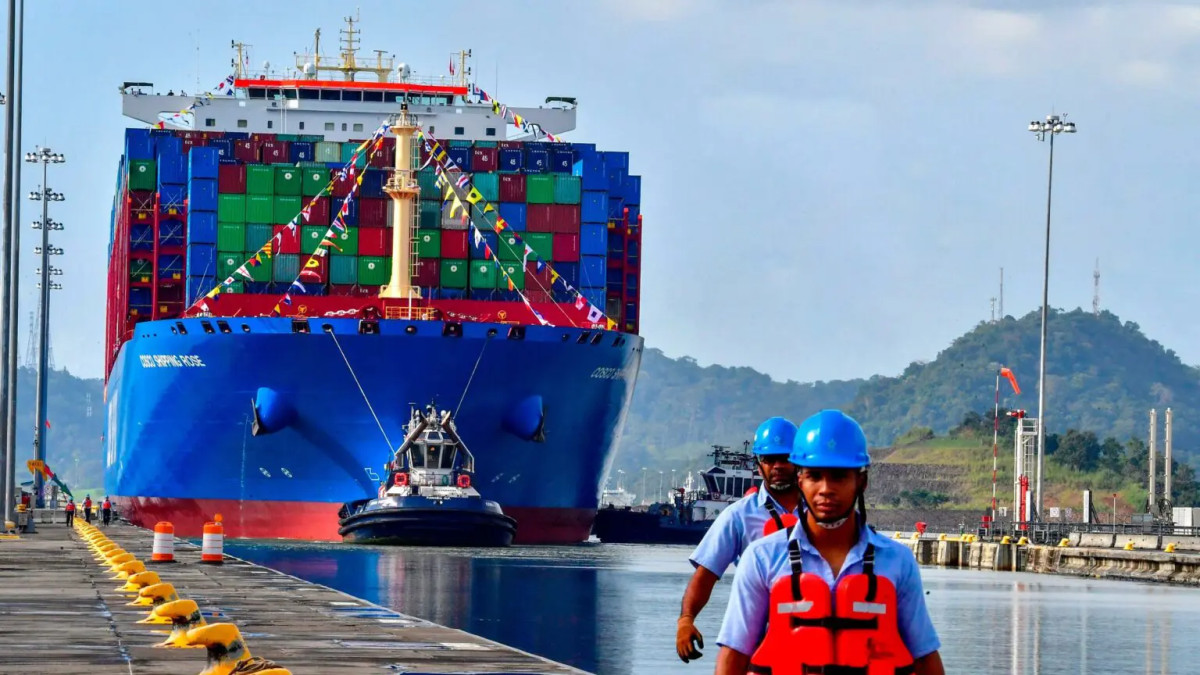
By terminating its Belt and Road Initiative agreement with China, Panama has sent a warning to Beijing that it cannot have its way anywhere it likes. Beijing also may lose control over the strategic Panama Canal, a control it was exercising through a Chinese company that was running two ports at either end of the canal.
U.S. President Donald Trump may be brusque in his ways, but he has set an example to the rest of the world how to keep under control the growing clout of China. With Beijing set to lose its foothold in Panama, the Chinese design to extend its influence in the very backyard of the United States has suffered a setback.
Early in February, soon after the inauguration of the Donald Trump government, U.S. Secretary of State Marco Rubio travelled to Panama City and told President of Panama Jose Raul Mulino Panama would have to face potential retaliation from the United States unless Chinese control over the Panama Canal area was immediately reduced.
The Panamanian leader was told that the presence of China in the canal area would violate a treaty which led the U.S. to turn the waterway over to Panama in 1999. For, the treaty called for the permanent neutrality of the canal build by America. “Secretary Rubio made clear that this status quo is unacceptable and that in the absence of immediate changes, it would require the United States to take measures necessary to protect its rights under the treaty,” the U.S. State Department said after the meeting.
The impact on Panama of the tough U.S. stand has been immediate. Panama has now decided not to renew the Memorandum of Understanding on cooperation with China on the BRI. President Mulino has said he would review agreements involving China and Chinese businesses. Panama, significantly, was the first Latin American country to have signed the BRI agreement with China, in 2017. President Mulino has also said that he is interested that the U.S. increases investments and infrastructure projects in Panama.
The Chinese company which has been operating the ports of Balboa and Cristobal located at the northern and the southern ends of the Panama Canal is a member of a holding company headquartered in Hong Kong. The contract with Panama to operate the Balboa and Cristobal Ports was first signed in 1997. In 2021, the contract with the Hong Kong- based company was renewed till 2047. Now the contract is under legal challenges in Panama; one on the ground that it violates a clause in the constitution of Panama that guarantees placing public good over private interests.
According to an AFP report quoting the judicial branch of Panama, the Supreme Court of Panama has agreed to consider a request filed by a lawyer to nullify the contract with the Hong Kong – based company. This was the second challenge to the contract after two other lawyers filed a case earlier this in February, claiming the concession to the firm was unconstitutional. The latest lawsuit would consider the “automatic extension” of the concession till 2047. An audit into the suitability of the extension is also under way.
The concern of the U.S. over increasing Chinese footprints in its backyard is not unfounded. Over the years, Chinese influence over the Panama Canal and the country of Panama has increased.
Latin American Research Professor with the U.S. Army War College R. Evan Ellis has written that the People’s Liberation Army of China maintains relationships with the Border Protection Service of Panama, the Air and Naval Service of Panama and the National Police of Panama. China Ocean Shipping Group Company or Cosco is one of the biggest users of the Panama Canal. Significantly, Chinese shipping giant Cosco also owns the mega port Chancay in Peru; another Latin American country.
The U.S., for which South America is the backyard, these are issues of strategic concern. These private Chinese companies can be dictated at any moment by the communist government to act as they wanted. “A foreign power today possesses, through their companies, which we know are not independent, the ability to turn the Panama Canal into a choke point in a moment of conflict; and this is a direct threat to the national interest and security of the United States,” Marco Rubio said last January. “If China orders a company to shut it down or impede our transit, they will have to do so.”
The grievances of the U.S. also have justification. Considered one of the man-made wonders of the world, Panama Canal was constructed by the U.S. between 1904 and 1914. The U.S. relinquished control of the canal to Panama in 1999. U.S. policymakers consider this a strategic mistake as the Panama Canal is a vital strategic and economic asset, providing a direct link between the Pacific Ocean and the Atlantic Ocean through the Caribbean Sea. The U.S. is the biggest user of the canal and 40 percent of the U.S. container traffic relies on the Panama Canal route.
There are strategic concerns for the U.S. too. In 2017, Panama severed diplomatic ties with Taiwan and established diplomatic relationships with the Peoples’ Republic of China. Since then, Beijing has been investing heavily in infrastructure projects near the canal. There is also apprehension in the U.S. that China could embed surveillance technology within the infrastructure of the canal, enabling espionage against logistical and military movements by the U.S.
Interestingly, back in 1914, a German magazine called Ueberall wrote about the strategic importance of the Panama Canal thus: “Without the canal the United States could only arrange for adequate protection to both its Atlantic and Pacific coasts by means of two fleets. Upon the completion of the canal, a transfer of the one fleet from one ocean to the other will be a matter of but a few hours. The possession of such a canal by a foreign power would enable an enemy fleet to effect the change from one ocean to the other without the knowledge of the U.S. and would afford their opponents the means to effect a surprise.”