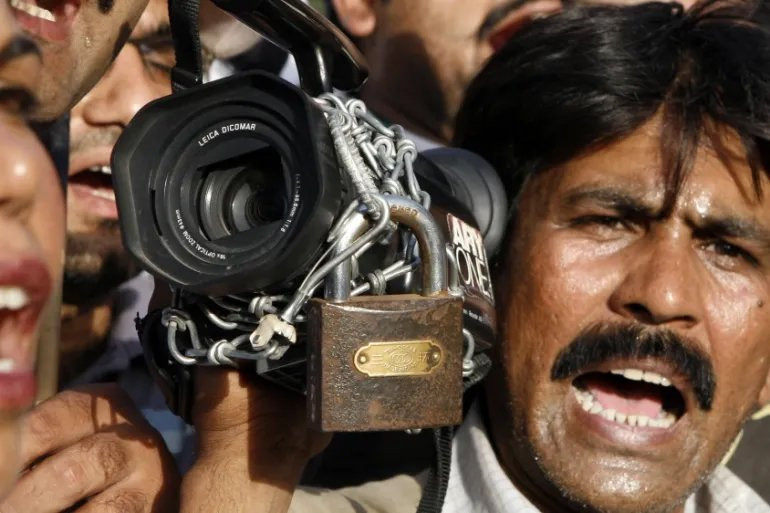
Pakistan’s media environment continues to face increasing restrictions, where state institutions, particularly the military and intelligence services, exert substantial influence over both traditional and digital journalism. Coverage that questions or investigates these institutions is often considered off-limits, forming part of a broader effort to suppress dissent and limit transparency.
A recent report titled Intimidation on All Fronts: Press Freedom and Media Safety in Pakistan, published in advance of World Press Freedom Day 2025, highlights the growing challenges faced by journalists across the country. The report outlines a troubling pattern of coercion, surveillance, censorship, and harassment directed at media professionals. Although Pakistan’s constitution guarantees freedom of speech and press, these rights are routinely undermined in practice. The country now ranks 152nd out of 180 nations in the 2024 World Press Freedom Index, reflecting a significant and continuing decline.
The historical context of press restrictions in Pakistan is deeply rooted in the country’s political trajectory. During General Ayub Khan’s government in the 1960s, laws were introduced that criminalized criticism of the state. These measures were further intensified under General Zia-ul-Haq, whose regime is remembered for its sweeping censorship of the press. Under General Pervez Musharraf, a more modernized yet still restrictive model emerged, culminating in the establishment of the Pakistan Electronic Media Regulatory Authority in 2002. While ostensibly created to regulate electronic media, the authority has increasingly been used to enforce state narratives and penalize dissent.
In recent years, legal mechanisms have been further expanded to control digital spaces. The Prevention of Electronic Crimes Act, passed in 2016, was initially introduced as a tool to combat cybercrime. In implementation, however, it has frequently been used to target online journalists, bloggers, and civil society actors. The Protection of Journalists and Media Professionals Act of 2021, which was intended to safeguard press freedom, contains clauses that condition protections on compliance with government-defined standards, effectively narrowing the scope of its application. Amendments introduced in 2025 have further broadened the definition of punishable offenses, particularly in digital reporting.
These developments have coincided with a rise in state interference during politically sensitive periods, most notably during the 2024 general elections. Mobile and internet services were suspended in several regions, including the capital Islamabad, following directives from the Ministry of Interior and the Pakistan Telecommunication Authority, then headed by retired General Hafeezur Rehman. The outages disrupted media coverage and impaired the public’s access to electoral information.
Concerns have also been raised about the proposed creation of the Pakistan Media Development Authority, a body envisioned with expansive powers to dissolve media outlets and prosecute journalists through special tribunals for content deemed offensive to state institutions. Critics argue that the authority would function not as a regulator but as an enforcer of ideological conformity.
Legislative pressure has been complemented by financial constraints. Government advertising, which plays a crucial role in sustaining many publications, has been withheld from outlets perceived as critical of the state. Newspapers such as Dawn and Daily Sahafat have experienced revenue losses as a result of these bans. Conversely, media organizations considered aligned with government interests have continued to receive favorable treatment.
The role of Pakistan’s Federal Investigation Agency has also expanded. Journalists have reported being summoned, interrogated, and in some cases detained without clear charges. These actions often occur without judicial oversight and reflect a broader environment in which journalists work under constant threat of reprisal.
The risks faced by media professionals in Pakistan are not limited to censorship and financial pressure. Physical threats, abductions, and killings have become increasingly common. In December 2022, bureau chief Naseer Ghumman was shot following investigative reporting on local corruption. Earlier that year, journalist Arshad Sharif was killed in Kenya after fleeing threats in Pakistan. The case, initially described as a mistaken identity, was later widely regarded as a targeted assassination. His widow, Javeria Siddique, who is also a journalist, has since faced sustained online harassment. Other cases, including the detention of Hayatullah Khan’s brother and the repeated arrests of BOL News staff in 2023, further illustrate the dangers confronting the press.
According to the Pakistan Press Foundation, seven journalists were killed in the first half of 2024 alone. Among them was Khalil Jibran, a veteran journalist who had survived multiple previous assassination attempts. Others, including Saad Ahmed and Hasan Zaib, were also targeted and killed in attacks that remain unsolved. These incidents underscore the risks associated with reporting on politics, security, and corruption.
Intimidation, detention, and enforced disappearances have become routine tactics. Prominent journalist Imran Riaz Khan has been arrested multiple times. In February 2024, nearly fifty journalists and digital content creators were summoned for questioning after publishing criticism of the judiciary. A growing number of journalists have left the country, citing threats to their safety and deteriorating working conditions. The Committee to Protect Journalists reports that 64 media professionals have been killed in Pakistan since 1992.
In the year 2025 alone, the Pakistan Press Foundation recorded at least 34 cases involving physical assault, kidnapping, threats, or digital harassment of journalists. These are not isolated incidents. They reflect a systematic approach to restricting press freedom and silencing independent voices. As legal and institutional pressures mount, the capacity of the Pakistani press to function as a check on power and a source of public accountability faces an increasingly uncertain future.