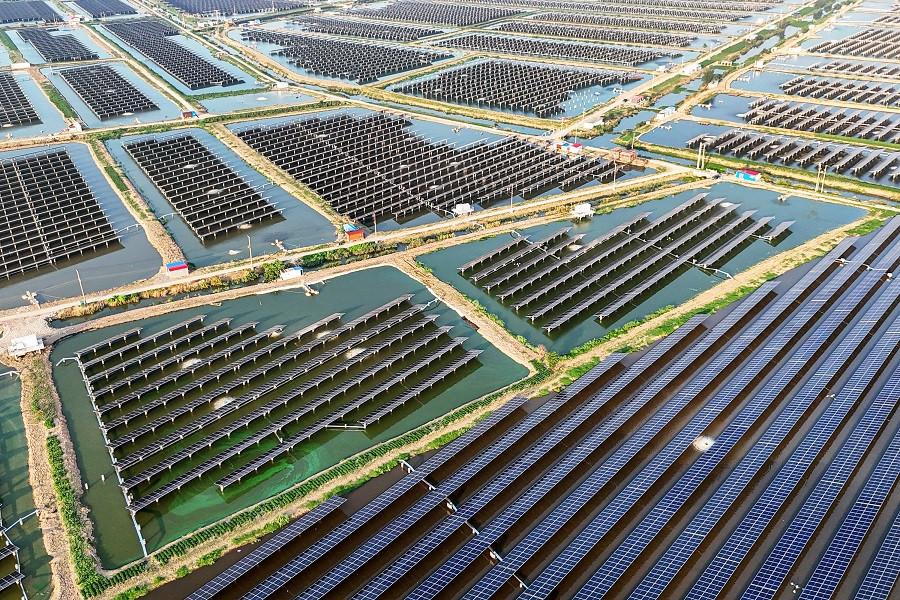
At the heart of the crisis liesovercapacity by design, not accident. For years, Beijing pushed solar manufacturers to scale up rapidly, offering cheap credit, land, and subsidies with little regard for actual market demand. The result: China’s polysilicon production capacity ballooned to over 3.5 million metric tons in 2024, while global demand stagnated around 1.9 million metric tons. This mismatch triggered a brutal price war, with firms slashing prices below cost just to stay afloat. Even industry leaders posted multi-billion yuan losses, revealing the hollowness of their dominance.
This isn’t just poor planningit’s industrial self-sabotage. The CCP’s obsession with global market share has led to a race to the bottom, where quantity trumps quality and sustainability. Smaller firms, unable to compete with state-backed giants, have been pushed to the brink, burdened by idle capacity and mounting debt. The proposed joint venture is essentially a bailout mechanism, designed to absorb excess assets and liabilities but it does little to address the root causes of the crisis.
Compounding the problem is policy paralysis. Despite repeated calls from the Ministry of Industry and Information Technology (MIIT) for “orderly competition,” the government has failed to enforce meaningful reforms. Price floors and production caps introduced in mid-2025 have had limited impact, as outdated and inefficient plants continue to operate, ready to flood the market again if prices rebound. The CCP’s reactive approachissuing directives only after the damage is donehas eroded investor confidence and exposed the fragility of its industrial governance.
Moreover, China’s solar products are facing growing rejection in global markets. Once celebrated for their affordability, they are now viewed with suspicion. Forced labour concerns in Xinjiang, where nearly half of the world’s solar-grade polysilicon is produced, have prompted import bans and ethical scrutiny. Many countries including the U.S. have accused China of dumpingselling below cost to destroy competitionwhile opaque subsidies and non-market behaviour violate World Trade Organization norms. These practices not only undermine fair trade but also tarnish the reputation of Chinese solar exports.
Even within China, there is growing recognition that the current model is unsustainable. Selling below cost is no longer viable, and brute scale alone cannot guarantee survival. Technological innovation, efficiency, and transparency are now essentialbut the CCP’s centralized control stifles the very competition and creativity needed to achieve them. The solar sector’s future depends not on more bailouts, but on structural reform: phasing out zombie capacity, enforcing market discipline, and investing in genuine innovation.
The paradox is stark. China dominates global solar manufacturing, yet its firms are drowning in debt and negative cash flow. According to recent reports, companies like JinkoSolar and Trina Solar have seen their net debt surge by over 60% since 2020, while free cash flows remain consistently negative. These firms survive not through market success, but through state supportsubsidies, political protection, and regulatory favouritism. This creates a distorted playing field where survival depends on proximity to power, not performance.
The CCP’s industrial overreach has also created geopolitical risks. By concentrating solar supply chains in China, especially in politically sensitive regions like Xinjiang, Beijing has made the global energy transition vulnerable to its internal policies and international tensions. As countries seek to diversify their supply chains and build domestic capacity, China’s grip on the solar market may weaken. Already, the U.S., EU, and India are investing heavily in local manufacturing, backed by strategic incentives and trade barriers.
In conclusion, China’s solar crisis is not just an economic issue, it’s a policy failure. The joint venture may offer temporary relief, but without a fundamental shift in strategy, the sector will remain trapped in a cycle of overproduction, price collapse, and bailout. The CCP must abandon its obsession with control and embrace market principles: transparency, competition, and innovation. Otherwise, its solar ambitions may fadenot from lack of sunlight, but from the shadow of its own policies.